SPIN-SLAM: Towards Real-Time Monocular Gaussian Splatting SLAM in Dynamic Environments
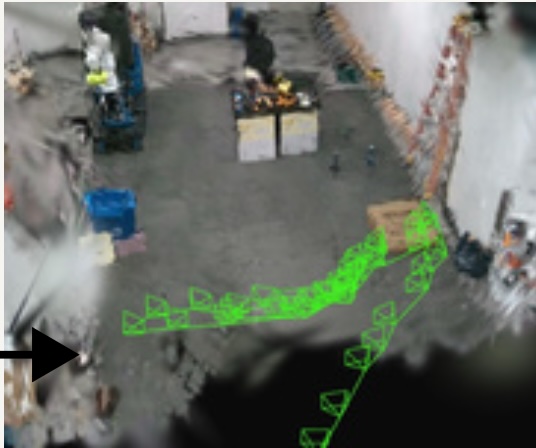
Autonomous agents need a precise mapping of dynamic environments containing humans, animals, or even objects they interact with to navigate efficiently and safely in the world around them. However, most SLAM (Simultaneous Localization and Mapping) methods assume a static world, meaning they bake visual artifacts into the 3D map that hinders tracking and hurts visual fidelity. We demonstrate that the masking can be done 61.9x cheaper than the state-of-the-art while being within 0.6 dB PSNR of its rendering quality.
Methods like WildGS-SLAM use the deep-feature model DINOv2 every frame and feed the output to an uncertainty MLP trained online. On our workstation (Intel Core i7-9700, 64 GiB RAM, RTX 4090), its masking time with this method is 6256.7 ms per keyframe. DROID-W drops the online mapping and uses the features more efficiently and reaches 13.03 FPS, but it still needs a depth estimator on every keyframe.
However, the tracker used in these methods holds information that could be reused to mask the distractors: a temporal residual from its own pose/depth and a render of the live Gaussian map. Therefore, we do not need a semantic network and only retain a metric depth estimator queried every 10 keyframes only (20.6 ms amortized).
We combine the Tracker and the Mapper more efficiently with an adapted shared memory and reduce the keyframe count without hurting quality with DiSC-KF, a Disambiguality-Scored Covisibility keyframe selector. We also apply two geometrical vetoes to remove static elements from the rough masks. We achieve 80.5 ms masking (101.1 ms with the amortized depth query) at 23.05 FPS, or 0.77x the sensor rate.
*accepted for Late Breaking Result (LBR) track